Students marked 100 years since Paulo Freire's birth, this term
Paulo Freire may not be well known in the UK but he's one of the most influential thinkers in education.
His arguments for critical thinking in schools and universities have shaped teaching well beyond Brazil, where he was born 100 years ago.
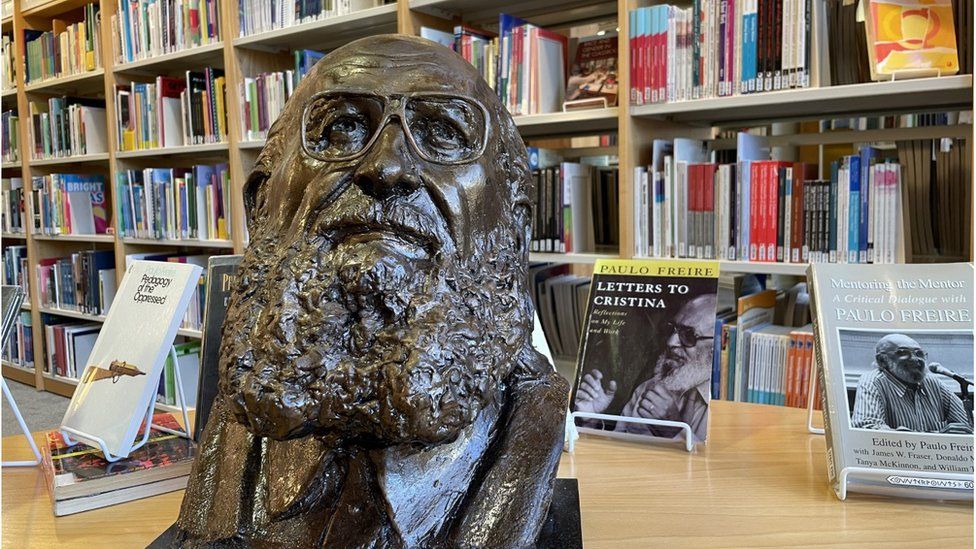
Now, a group of leading academics at the University of Cambridge have installed a bronze sculpture of him in the library at the Faculty of Education, just south of the city centre, as a symbol of "tolerance and dialogue" at a time of "culture wars" on campus.
But he died in the late 1990s, so why is it going up now?
Far-right President Jair Bolsonaro has even threatened to "enter the education ministry with a flamethrower" to remove every trace of his teaching.
"In Brazil, our current situation is very, very difficult," Alex Trindade, one of the Brazilian students who came up with the idea of the sculpture, says.
"Bolsonaro is attacking everything related to public universities, Freire's ideas.
"The idea is to not... allow professors or teachers or schools to discuss politics or gender or anything that is connected, that gives a way for people to develop their own ideas."
In her office, surrounded by heaps of education books and an impressive collection of houseplants, faculty head Prof Susan Robertson says Freire's emphasis on the importance of "listening, tolerance, and dialogue" has become all the more important in the context of "cancel culture".
The practice of "cancelling" people because their views may be offensive or of denying them a platform to speak has become a subject of heated debate not only on social media but also on campuses.
This month, the Cambridge Union Society banned art historian Andrew Graham-Dixon after he offended students by impersonating Adolf Hitler, during a debate over whether there was such a thing as "good taste".
And this week - after Prof Kathleen Stock, accused of transphobia for her views on gender identity, quit her post at the University of Sussex, saying she had had "a horrible time" - Equalities Minister Kemi Badenoch told the House of Commons Cleese was "quite right" to highlight the importance of freedom of speech and belief in universities.
The Department for Education chose not to comment for this feature.
Prof Susan Robertson is the head of the Faculty of Education, where the sculpture has been installed
For Prof Robertson, every instance of speech deemed to be offensive should be considered but, in general, cancel culture "hoses down possibilities of listening and hearing each other and then working forward".
"How do we actually talk about difficult issues that we might have different views about?" she asks.
"It's those qualities that [Freire] would actually say are absolutely desperately needed to get our way out of really some fairly challenging polemical positions."
Prof Stock recently told the BBC protests against her were like a "terrible anxiety dream"
But the sculpture is also a symbol of "resistance to far-right attacks on education".
Pointing to "aggressive attacks" on educators in countries such as Brazil, Prof Robertson warns there are also issues in the UK - although, there is "clearly a difference".
"What we have seen here, however, is a consciously over-simplistic positioning of academics and educators as distant and out of touch," she says.
And efforts to "decolonise" the curriculum are one example.
Vile abuse
This topic has reached boiling point at various institutions, including Cambridge.
In 2017,a former student was sent vile abuseon social media for asking for more authors belonging to ethnic minorities to be added to its English course.
Her photo was splashed on the front page of the Daily Telegraph, under the headline: "Student forces Cambridge to drop white authors."
A correction was issued later.
The Blob
Efforts to make the curriculum more inclusive have also led the media to portray academics as "dangerous, left-wing activists intent on 'cancelling' key texts or thought-policing staff and students", Prof Robertson says.
"Similar accusations are sometimes levelled at students themselves, for raising concerns about issues like climate change or gender identity," she says.
"These are complicated issues, which require careful thought, open, respectful discussions and an acknowledgement of different points of view."
Michael Gove, while he was educational secretary,dubbing the educational establishment The Blob, a reference to the 1950s film about an amoeba-like alien mass, was "an effort to deride unions, teacher strikes and certain styles of teaching", Prof Robertson says.
"Depicting teachers or students as hysterical, oversensitive, or virtue signalling not only closes down the debate, it also implicitly justifies one narrow and unchanging set of views about what education should be," she adds.
Her faculty says there is "alarm at how universities and schools are being targeted in often-fabricated 'culture-war' debates, not least in Britain and the United States".
And while these are "less violent" than in other countries, "many use similarly toxic rhetoric to promote anti-progressive approaches to education".
The Cambridge Union Society's tag line is: "Defending free debate since 1815"
But Hugo Williams, who chairs the Cambridge University Conservative Association, says it is not "at all fair" to compare far-right attacks on universities to "the interventions by politicians and journalists concerned about free speech and academic freedom".
"I don't think, in the latter case, that politicians and journalists are targeting universities," he says.
"They are instead drawing attention to issues that are often already concerns of students and academics.
"A robust defence of the policies being criticised in the media would be a more credible response than complaints about being 'targeted'."
Mr Williams is "glad that the [Cambridge] Union [Society] will remain a place where students can hear challenging and controversial opinions".
Last year,the university voted against proposed rulesthat would have required staff, students and visiting speakers to remain "respectful" of the views and "identities" of others.
They "would have been damaging to academic freedom", Mr Williams says.
"Many people were encouraged by the fact that an overwhelming majority of academics in Cambridge are still willing to defend academic freedom, albeit in a secret ballot," he adds.
The actor Stephen Fry was also among those worried about the threat to free speech, saying calls for "respect" might have been well intentioned but people could not "demand" their views be respected.
Questions over freedom of speech, freedom of choice and what should and should not be taught at universities and schools are fuelling debates around the world.
Alex Trinidade is part of a group of Brazilian activists at Cambridge
Statues themselves have been a key symbol in debates over the legacy of colonialism in recent years, especially since the murder of George Floyd and Black Lives Matter demonstrations last year.
In Cambridge itself, a bronze cockerel looted in a British raid was removed from display at Jesus College, in 2016, andreturned to Nigeria last month.
But here in the faculty, a sculpture is now going up.
Inspire people
Mr Trinidade says he and his fellow Brazilian student activists had initially hoped it would raise awareness about attacks on education in Brazil and symbolise the importance of access to education.
But now he has a third objective - to "inspire" people, especially from places such as Latin America, to know "they can do more" when it comes to forming education practices at such a crucial time.
"They can perceive themselves as we perceive ourselves - not only as individual academics, but as responsible," he says.
RE 1.017.365 de SANTA CATARINA, posse tradicional indígena e proteção ambiental
A discussão sobre o denominado “marco temporal” pode ser finalizada esta semana pelo Supremo Tribunal Federal. O tema é complexo, e a importância do julgamento vai muito além dos direitos e garantias consagradas pela Constituição Federal de 1988 em favor das comunidades indígenas e povos tradicionais e abrange aspectos jurídicos e econômicos de grande relevância, com reflexos direto na área social e, especialmente, ambiental. Esse contexto inflama o debate que tem importante interesse do empresariado ligado ao agronegócio e à mineração.
Com efeito, a demarcação de terras indígenas é um desafio que o Governo Federal tem enorme dificuldade em apresentar uma resposta satisfatória, seja à sociedade de modo geral, seja em relação as comunidades indígenas de maneira mais específica. Hoje a Fundação Nacional do Índio se debate com quase 250 processos pendentes sobre demarcação de terras indígenas, número que segundo associações e ONGs ligadas a causa indígena seria muito superior. Falta orçamento e, consequentemente, pessoal especializado nos quadros da Funai, algo na mesma linha do que acontece com o IBAMA, diante de um desmonte institucional e estratégico que ultrapassam décadas de absoluto desinteresse pelo tema nos governos que se seguiram.
É quando tangenciamos o tema ambiental que conseguimos trazer a lume a importância da demarcação e proteção das terras indígenas que representam algo em torno de 12% do território nacional – número verdadeiramente significativo pois isso equivale ao território da França e Inglaterra somados -, mas que suporta somente 1,6% do desmatamento ilegal registrado nos últimos anos. Do ponto de vista ambiental, dos tratados e acordos internacionais subscritos pelo Brasil, isso significa que garantir de forma plena os direitos originários às terras tradicionalmente ocupadas (art. 231, CF) responde ao interesse coletivo nacional e global, além de, é claro, das comunidades indígenas que ainda lutam pela demarcação de seus territórios.
Nesse contexto, de absoluta incapacidade da Administração, em todos os seus níveis, em combater a degradação ambiental que nos afronta diariamente – e aqui lembras do vídeo que circula nas rede sociais desde de o último dia 28 mostrando trecho do Rio Javaé, em Formoso do Araguaia, completamente seco -, uma decisão firme (e unânime) do Plenário do Supremo Tribunal Federal seria um alento para a combativa comunidade indígena e para parte importante da sociedade brasileira que tem sensibilidade para constatar que a espiral de degradação ambiental que nos encontramos trará consequências ainda mais devastadoras a curto prazo.
Embora 20% do território brasileiro já esteja ocupado por pastagens e o desmatamento ilegal mantenha crescimento vertiginoso ano após ano, a dificuldade enfrentada pelas grandes potências econômicas para consolidar a produção de energia limpa, frente a uma demanda crescente, em especial a da China, a decisão da Suprema Corte brasileira poderá ter a médio prazo importância geopolítica de grande relevância para o Brasil no contexto internacional. Ainda que hoje essa perspectiva seja pouco valorizada por setores governamentais e empresariais, nosso território ainda detém, por exemplo, 12% da agua doce existente, parte importante dentro de reservas indígenas, e com uma decisão que derrube de uma vez por todas a tese do “marco temporal” a importância brasileira no equilíbrio ecológico global pode se manter relevante a médio e longo prazo.
Por óbvio que não se olvida dos interesses dos agricultores catarinenses que teriam adquirido as terras junto ao Estado, nesse caso específico da Terra Indígena Ibirama La-Klãnõ, mesmo destacando que o parágrafo 6º do mesmo art. 231 da CF já pronuncia a nulidade de tais dos contratos firmados tendo como objeto terras tradicionalmente ocupadas, será perfeitamente viável, técnica e juridicamente, que o Supremo estabeleça, no mesmo acordão, o prazo para a desocupação da área e o direito de indenização dos agricultores prejudicados.
O voto condutor do Ministro Edson Fachin, já amplamente divulgado, não deixa margem de dúvida do ponto de vista constitucional: a tese do “marco temporal” não tem embasamento legal mínimo e, portanto, não deve se sustentar perante o Plenário, por mais forte que sejam as pressões políticas e de parte do empresariado. De outra banda, a orientação lançada no voto de 109 laudas, também não permite que o processo demarcatório seja feito de forma discricionária e sem o respeito a padrões técnicos, em especial do ponto de vista antropológico, ou seja, impede que as áreas demarcadas, ou a serem demarcadas, superem aquilo que realmente representa o direito originário dos povos indígenas (art. 231 CF), evidenciando ainda que, dentro do devido processo legal, poderá ocorrer o redimensionamento das terras demarcadas, garantido direito a posse tradicional indígena e o direito fundamental à propriedade particular também salvaguardada expressamente na Constituição.
Sudão vai entregar ex presidente ao Tribunal Penal Internacional
Presidente sudanês Omar al Bashir a 19 de Agosto de 2021 ao comparecer em Cartum perante a justiça.Ebrahim HAMID AFP/File
O anúncio foi feito pela ministra dos negócios estrangeiros, Mariam Al Mahdi, numa audiência, em Cartum, com o novo procurador geral do TPI, Karim Khan.
A medida foi tomada em Conselho de ministros e permitirá, segundo a chefe da diplomacia sudanesa, obter justiça para as vítimas da guerra no Darfur.
O dispositivo tem ainda que ser debatida entre o governo e o Conselho soberano, a maior instância responsável pela transição.
O Darfur, na região ocidental do Sudão, foi palco desde 2003 de um conflito opondo o regime de maioria árabe de al Bashir aos rebeldes oriundos de minorias étnicas que denunciavam a marginalização de que eram alvo.
A guerra fez cerca de 300 000 mortos e quase 2,5 milhões de deslocados, segundo dados das Nações Unidas.
Al Bashir, de 77 anos, foi derrubado em Abril de 2019 após 3 décadas no poder, de um regime com mão de ferro.
Indígenas denunciam Bolsonaro em Haia por genocídio
Pedido de investigação pelo Tribunal Penal Internacional alega que presidente cometeu crimes contra a humanidade e genocídio ao incentivar invasão de terras indígenas por garimpeiros e propagar covid, entre outras ações.
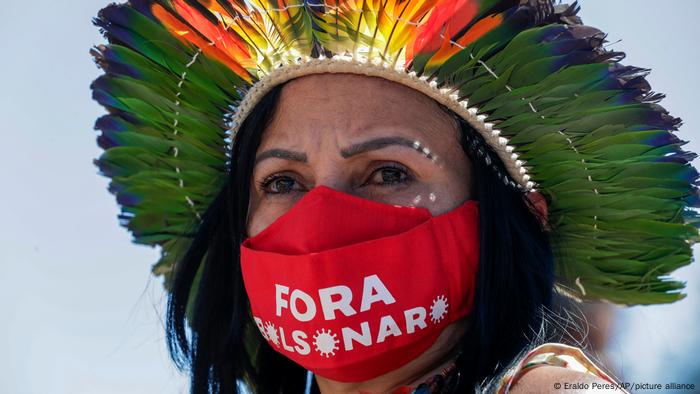
Mulher indígena protesta contra Bolsonaro em Brasília, em junho de 2021
O presidente Jair Bolsonaro pode ser o primeiro brasileiro a se tornar réu no Tribunal Penal Internacional (TPI). Um pedido de investigação por crimes contra a humanidade e genocídio praticados pelo presidente contra os povos indígenas foi protocolado na corte nesta nesta segunda-feira (09/08) pela Articulação dos Povos Indígenas do Brasil (Apib).
O extenso documento enviado à instância internacional, redigido por advogados indígenas, apresenta uma série de discursos, decisões - e omissões - registradas desde 1º de janeiro de 2019, início do mandato de Bolsonaro, que comprovariam a intenção de extermínio dos povos originários.
"A gente demonstra a falta de demarcação de terras, incentivo do presidente à pratica de desmatamento, garimpo e mineração em territórios indígenas. Isso mostra que há, sim, indícios de crime de genocídio, já que esses eventos colaboram para a destruição dos povos, aumento da violência e morte", afirma a advogada Samara Pataxó em entrevista à DW Brasil.
Em dezembro do ano passado, o TPI iniciou formalmente, de forma preliminar, a avaliação de um outro pedido de investigação feito por advogados brasileiros. No fim de 2019, após o aumento do desmatamento e das queimadas na Amazônia, o Coletivo de Advocacia em Direitos Humanos (Cadu) e a Comissão Arns enviaram uma comunicação ao tribunal alegando que os atos de Bolsonaro implicavam crimes contra a humanidade e incitação ao genocídio de indígenas.
"A nossa compreensão é de que, desde então, o presidente agravou os seus atos em relação aos direitos socioambientais e dos povos indígenas. Agora não se fala mais em incitação, mas em genocídio”, detalha Eloísa Machado, advogada do Cadu que colaborou com a Apib.
A tramitação do pedido no TPI ainda é incerta e, caso avance, pode ser bastante longa. "A nossa expectativa é causar um impacto politico e social. Nós, indígenas, temos medo de retaliações, de ataques, o que se tornou comum neste governo. Mas esperamos que a sociedade veja que nós criamos formas de reagir e que nos apoie", comenta Pataxó. "Esperamos também que sirva de incentivo a outros grupos que estão sendo atacados."
Crimes de genocídio e contra a humanidade
Sediado em Haia, na Holanda, o TPl foi criado com base no Estatuto de Roma, assinado em 1998, para julgar crimes de guerra, crimes contra a humanidade, de genocídio e de agressão de forma independente dos Estados.
Segundo o artigo 6º do estatuto que rege o tribunal, são considerados genocídio "atos cometidos com a intenção de destruir, no todo ou em parte, grupo étnico, racial ou religioso" - como homicídio; ofensas graves à integridade física ou mental de membros do grupo; sujeição intencional do grupo a condições de vida que provocam a sua destruição física, total ou parcial; medidas destinadas a impedir nascimentos; transferência à força de crianças.
São considerados crimes contra a humanidade, previstos no artigo 7º, ataques sistemáticos à população civil, como extermínio, tortura, escravidão, apartheid e outras condutas.
Para os advogados da Apib, Bolsonaro comete tais crimes ao incentivar a invasão de terras indígenas por garimpeiros e madeireiros; contrapor essas atividades, ressaltadas como "contribuições à economia brasileira", aos modos de existência indígenas; prometer liberar e legalizar o garimpo e não aplicar a legislação ambiental aos criminosos; não demarcar ou homologar terras indígenas; destruir a infraestrutura pública de garantia dos direitos indígenas e propagar a covid-19.
"Essa política afetou a vida, a saúde, a integridade e a própria existência dos povos indígenas no Brasil, com especial atenção para povos isolados ou de recente contato, os Mundukuru, os que vivem na Terra Indígena Yanomami, os Guarani-Mbya e Kaigang, os Guarani-Kaiowá, os Tikuna, os Guajajara e os Terena", diz o documento encaminhado ao TPI.
O que mostram os dados
Desde o início do mandato de Bolsonaro como presidente, a média do desmatamento na Amazônia cresceu 70% em relação à registrada entre 2009 e 2018 pelo Instituto Nacional de Pesquisas Espaciais (Inpe). Entre agosto de 2019 e julho de 2020, a floresta perdeu uma área de 11 mil km², a maior taxa registrada em 12 anos.
O aumento dos conflitos e da violência, que culminou em crimes emblemáticos como o assassinato de guardiões da floresta como Paulino Guajajara, morto a tiros na Terra Indígena Arariboia, é apontando no levantamento anual feito pela Comissão Pastoral da Terra. Em 2020, das 18 lideranças de movimentos sociais por acesso à terra assassinadas no país, sete eram indígenas.
Além da disputa pelo território, o garimpo, mesmo sem regulamentação, já provoca graves problemas a essas populações, como surtos de malária e poluição ambiental, além de ataques. Em março último, a sede da Associação de Mulheres Munduruku Wakoborun, no Pará, foi depredada e incendiada por garimpeiros. No território Yanomami, na divisa entre Amazonas e Roraima, lideranças denunciam há meses a presença de mais de 20 mil invasores em busca de ouro, que já destruíram uma área estimada em mais de 500 campos de futebol.
"A disputa pelo território é a base sociológica da violência praticada contra os povos indígenas e suas lideranças", afirma o documento enviado ao TPI. "A política anti-indígena em curso no Brasil hoje é dolosa. São atos articulados, praticados de modo consistente durante os últimos dois anos, orientados pelo claro propósito da produção de uma nação brasileira sem indígenas, a ser atingida com a destruição desses povos, seja pela morte das pessoas por doença ou por homicídio, seja pela aniquilação de sua cultura, resultante de um processo de assimilação", alegam os advogados.
Atualmente, o país conta com 305 povos indígenas, 114 povos isolados e de recente contato, falantes de mais de 270 línguas diferentes. Eles habitam em torno de 1.300 terras indígenas - 408 delas formalmente reconhecidas pelo Estado.
Próximos passos
O pedido de investigação deve ser encaminhado ao gabinete da procuradoria do TPI, que faz uma análise preliminar. Ele só se transformará numa ação penal caso a procuradoria entenda que houve de fato os delitos alegados. Do contrário, o pedido é arquivado.
"No TPI vale o Principio da Complementariedade: a responsabilidade primeira para punir indivíduos que cometeram crimes de altíssima gravidade é do Estado. Se o Estado não pode, ou não quer punir, o TPI tem jurisdição para julgar", explica André de Carvalho Ramos, professor de Direito Internacional da Universidade de São Paulo (USP). "E quem decide se o Estado não pode ou não quer julgar é o próprio TPI", adiciona.
O Brasil reconheceu em 2002 a jurisdição da corte internacional, o que, segundo o entendimento de Ramos, possibilita a entrega de um brasileiro nato caso haja uma ordem do TPI. "Nesses crimes de alta gravidade não há qualquer tipo de imunidade", diz o professor, mencionando o Estatuto de Roma.
Na avaliação de Ramos, o pedido de abertura de investigação no TPI pode funcionar como um alerta, uma espécie de apelo, para que o sistema de Justiça brasileiro priorize essa demanda. "Quando envolve os povos indígenas, a relevância é evidente. É a questão de sobrevivência de um grupo importante", comenta.
Para os advogados que recorrem à instância internacional, não se trata de ganhar a ação. "A gente quer que Bolsonaro pare de promover crimes contra povos indígenas, que cesse a perseguição, o extermínio, essa politica de destruição ambiental", ressalta Eloísa Machado.
5.º Encontro de Investigadores em Ciências Jurídicas da Universidade do Minho.
Em nome da Comissão Organizadora agradeço, mais uma vez, o envio da sua proposta, que foi aceite para o 5.º Encontro de Investigadores em Ciências Jurídicas da Universidade do Minho.
A sessão webinar terá lugar no dia 20 de outubro de 2021 com o programa provisório que abaixo sugerimos e em relação ao qual aceitamos, ainda, sugestões de alteração.
Solicito que confirme o seu interesse em participar no evento.
Aproveito ainda para questionar se pretende alterar as filiações indicadas, conquanto que apenas poderão ser aceites duas afiliações e uma delas tem que fazer necessariamente referência ao Doutoramento.
Por fim, desejo-lhe umas férias retemperadoras, mantendo-me disponível para quaisquer esclarecimentos que entenda por necessários e/ou convenientes.
Até breve,
Pela Comissão Organizadora,
Maria João Lourenço
9h30m
Abertura
1ª sessão
- «Limites ao uso de novas tecnologias para interceptação das comunicações privadas pela Polícia Judiciária e pelos órgãos de inteligência estatal – SIS/pt e ABIN/br», Mestre João Souza (Doutorando na EDUM)
- «Direito Penal da Prevenção: a ultima ratio e a última rede», Mestre Rui Caria (Assistente-Convidado na Faculdade de Economia da Universidade de Coimbra e Doutorando na Faculdade de Direito da Universidade de Coimbra)
- «O Supremo Tribunal Federal brasileiro e a perda de normatividade do Direito positivo: a desidratação da Lei nº 13.964/2019 pela jurisprudência», Mestre Murilo Strazt (Doutorando na EDUM e na Universidade de Bordéus)
10h30m - Intervalo
11h
2ª Sessão
- «Os (prováveis) impactos da sustentabilidade fiscal na teoria geral dos benefícios fiscais», Mestre Bruno Sarmento (Doutorando na EDUM)
- «O paradoxo entre a prescrição, a segurança jurídica e a proteção da confiança», Mestre Márcia Gomes (Doutoranda na EDUM)
- «Existe um dever jurídico de resolução consensual de controvérsias para as Administrações Públicas brasileira e portuguesa?», Mestre Fernanda Karoline Oliveira Calixto (Professora da UNCISAL, Doutoranda na EDUM)
- «Da troca de informações entre Administrações Públicas: possibilidades e limites ao abrigo da legislação em vigor em matéria de proteção de dados pessoais», Mestre Joel Alves (Doutoranda na EDUM)
12h30m – Almoço
14h
3ª Sessão
- «Indemnização por danos imateriais individuais decorrentes da violação de dados pessoais na União Europeia e no Brasil – Breves contornos das primeiras decisões judicias», Mestre Afonso Oliva (Advogado, Coordenador do Núcleo de Prática Jurídica da Faculdade de Direito 8 de Julho, Doutorando na EDUM)
- «Inteligência Artificial e o Direito à Explicação no Regulamento Geral sobre a Proteção de Dados», Mestre Tiago Cabral (Advogado, Doutorando na EDUM)
- «A Proposta de Regulamento Inteligência Artificial da União Europeia e o seu modus operandis na cirurgia médico-robótica dotada de Inteligência Artificial», Mestre Ana Rita Maia (Assistente Convidada no IPCA, Doutoranda na EDUM)
- «La inteligencia artificial y el machine learning en el sector asegurador», Mestre Carlos Augusto Acosta Olivo (Profesor de la Universidad Tecnológica del Perú y en la Universidad Privada de Tacna, Doctorando en la Universidad Complutense de Madrid)
15h30m – Intervalo
16h
4ª Sessão
- «A habitação no programa nacional da política do ordenamento do território – que desafios?», Mestre Ana Palmira Gaspar Albino de Campos Cruz (Doutoranda na EDUM)
- «A importância da regulação das plataformas digitais de hospedagem colaborativa como instrumento para efetivação do direito à habitação no contexto da União Europeia», Mestre Cecília Pires (Doutoranda na EDUM)
- «A governação de empresas familiares – breves considerações acerca das questões sucessórias», Mestre João Nuno Barros (Assistente Convidado e Doutorando na EDUM)
When we speak, Karim Khan QC is in Malaysia, flying back from delivering his final report as Special Adviser and Head of UNITAD, the United Nations Investigative Team to Promote Accountability for Crimes Committed by Da’esh/Islamic State in Iraq and the Levant, at the Security Council in New York.
Starting out at the Bar in 1992, Karim did not want to be ‘pigeonholed’ because of his background (Pakistani father, British mother – an ethnic minority in England) in immigration law or crime. His father advised him not to concern himself with financial considerations; to focus on what he most enjoyed. Karim cut his teeth at the Crown Prosecution Service. When he saw the horrors of the Balkans war on CNN and learnt that the International Criminal Tribunal for Former Yugoslavia (ICTY) had been established, he aspired to work there one day. Karim’s applications went into a ‘black hole’ but he persevered, eventually becoming the first from the English Bar to be recruited by the Office of the Prosecutor at the ICTY, in The Hague.
That was the beginning of a career not only as a prosecutor but as a defence counsel and victims’ counsel in the ICTY, the International Criminal Tribunal for Rwanda (ICTR), the Extraordinary Chambers in the Courts of Cambodia (ECCC), the Special Tribunal for Lebanon, the Special Court for Sierra Leone (SCSL), Special Panels for Serious Crimes in Timor Leste and at the International Criminal Court (ICC). On 16 June 2021, Karim became Chief Prosecutor at the ICC in The Hague, the first British barrister to be elected to that post.
When he was called to the Bar, international criminal law did not exist as a field of practice. So I start by asking how he ended up practising in this area. ‘I did my pupillage at 5 Paper Buildings (Chambers of John Matthews QC) in the Temple, a specialist criminal law Chambers,’ he tells me. ‘I expected to have a criminal law practice, having also secured an offer with the CPS. That said, I was extremely keen on human rights law from the outset. I certainly did not foresee how the Human Rights Act of 1998 [would become] central to every part of domestic law, or how international criminal law [would take] off in the way that it has.’
He read law at King’s College, London and was already involved in human rights work: ‘I am a member of the Ahmadiyya Muslim Community,’ he explains, ‘which faced heavy persecution in Pakistan. [Dictator] General Zia-ul-Haq... enacted Military Ordinance XX which made it a criminal offence in Pakistan for members of my community to call ourselves Muslims or “pose” as Muslims in any way. Many were killed or imprisoned or sought asylum outside of Pakistan. Unfortunately, that law and state-sanctioned persecution against Ahmadi Muslims, and also Christians and others, continues today. I think my voluntary work at university, and in my community, helped me gravitate to this area.’
What else spurred him on? ‘The war in the Balkans was raging. I encountered many refugees in the UK and was touched by the reporting that put a spotlight on that awful conflict. The prospect of justice for crimes of such magnitude just seemed the right thing to do and incredibly exciting.’
He was determined to work at the ICTY and kept applying until he was successful some years later. Karim has made his name in the field, acting in some of the most prominent cases reaching international criminal and hybrid courts (from Temple Garden Chambers) including as Lead Counsel for the largest group of victims in the ECCC arising out of the Khmer Rouge period, Lead Counsel representing the Deputy President of Kenya, Ruto against ICC crimes against humanity allegations arising from violence following Kenya’s 2007 national elections (Karim ensured his acquittal), representing the Former Prime Minister of Libya during the government of Gadaffi, charged with crimes against humanity and corruption in the courts of Libya following extradition from Tunisia (Baghdadi A-Mahmoudi case). Karim also acted at the confirmation state of proceedings for Jean-Pierre Bemba Gombo, Former Vice President of the Democratic Republic of Congo for crimes allegedly committed in the Central African Republic (Bemba was eventually acquitted by the ICC) and was Lead Counsel until June 2007 to Charles Taylor, former President of Liberia, before the SCSL, the first African president to be prosecuted at an international court.
‘The cases are huge,’ he tells me. ‘It takes a team to work on them.’ These are extremely complex cases which need (as Peter Haynes QC put it during a training session I attended for counsel before the ICC) commitment: they can last over ten years. We discuss how the work of a barrister in such international fora extends beyond the courtroom into the field – investigating, collecting evidence – areas in which a barrister would not usually get involved.
Karim feels that ‘our tradition in common law, being able to have the experience of prosecuting and defending, representing victims, is wonderful. It… keeps one grounded’. He expands: ‘Realising that your opponent in the courtroom is an opponent in a case, not an opponent in life, is important. [W]hat is always corrosive is if you are prosecuting and you feel you are doing “God’s work” or if you feel that the defence is the representative of the devil’s incarnate. We need to be moderate, to be objective. The ability to work on different sides is a wonderful privilege that enriches one’s practice and fosters the objectivity which is essential to good advice.’ The word ‘humbleness’ crops up many times during our conversation, and he also emphasises the importance of diversity – going, as he put it, beyond the ‘white male anglophone’ or ‘French white Paris Sorbonne’ in the composition of legal teams acting in such cases.
‘If you are to succeed in the international plane,’ he notes, ‘one needs a mix of different legal systems, gender, languages and culture in a team. We are working in other peoples’ countries with their own history with their own politics,’ he stresses. ‘One cannot come in as some sort of legal commando, you cannot... parachute in with Archbold International in one’s backpack and think you can succeed, investigate and prosecute... One needs also to study the situation in the country, learn its history and culture and become acquainted with its politics. To do this effectively and in a time efficient manner it is also essential to… work with lawyers and investigators who come from and know the country or the region concerned - and its people and dynamics. I really believe one must have the humility to be a student and start understanding the realities on the ground. If one simply seeks to transpose applicable international criminal law in a country, without awareness of the undercurrents, of the richness of that country’s history and traditions, or the complexity of its politics, ethnic, cultural, religious allegiances or dynamics, you can look like an idiot and become unstuck very quickly indeed!’
I mention that the President of the International Court of Justice, in a recent speech marking its 75th anniversary, noted the ‘unsatisfactory situation’ that ‘very few of the counsel [appearing before the ICJ] are from developing countries’. She added that ‘while there are many aspects of international law on which jurists of all stripes can be expected to agree, we must acknowledge that there is no single, homogenized answer to many legal questions that arise in international disputes. As much as each individual may aspire to a cosmopolitan perspective, we must all have the humility to appreciate that we are shaped by our respective experiences. We must actively seek differing perspectives and promote open exchanges of ideas, especially with those whose views differ from our own.’
Should this need for diversity be kept in mind by leading counsel who have influence in forming the legal teams before international courts, I ask. Karim agrees: ‘I think it is essential, quite frankly, and not just at the Bar. Diversity is essential in all areas of human endeavour.’
He shares a fascinating anecdote about Professor Abdul-Salam of Imperial College, London, a family friend and the Muslim world’s first Nobel Prize winner for theoretical physics, who was ‘one of the main advocates for opening up diversity and way ahead of his time’. He refers me to what another professor of theoretical physics, Jim Gates, observed about Salam.
Gates said: ‘When we look at diversity in an area like physics, many people leap to the conclusion that discrimination is the cause or the lack of minority participation. Others believe that it is a lack of ability or dedication. I've concluded there may be something quite different at work. Suppose we lived in a world where the only kind of music that existed was classical music and some bright young person came along and learned classical music, but then created jazz. How does the existing establishment view him? He's not playing by their rules. Some people might say he's not playing by any rules. So the difference in aesthetic plays an enormous role. I have a strong suspicion something like that's at work in theoretical physics. In the early eighties Professor Salam commented that when a sufficient number of people of the African Diaspora start to do physics, he suspected something like jazz would appear… You see, there are different styles in how physics is done. There are styles of physics that are Russian, Germanic, English, and even American, which is very detectable to me. When enough people of African heritage do physics, they're going to bring a different aesthetic, and it will be new and valuable. Because classical music and jazz exist we don't think that we're musically poorer. Had jazz never come into existence we would've been musically poorer… And that's what's lost when people with different inputs don't participate in science. We miss the opportunity to create jazz.’
Karim thinks that the same applies to law. And that this diversity may also be about your place of origin. I tell him that living in a country in strife allowed me to observe things that later became crucial to the manner in which I plead crimes against humanity cases as counsel. Kids who have grown up in war zones may become the great international lawyers of tomorrow because they are seeing certain things that someone growing up in the West does not see, I suggest.
He agrees: ‘If you come from a background in which you don’t have electricity or if you grow [up] in the middle of conflict, you bring a different perspective. You can read all you want, but this does not compare to experience of life. We need to bring the understanding of such experiences into every area of human endeavour including the law. It enriches the law.’
I ask what has been the best part of his work, so far? He does not hesitate: ‘It is the people that I have met, the survivors particularly, the communities affected, that have had a profound impact upon me rather than the jurisprudence of the cases, important though that undoubtedly is. If one is involved in Cambodia, Former Yugoslavia, Sierra Leone, one meets a diverse group of people mostly characterised by immense courage – people that overcome lack of education, poverty, trauma... who have the will to survive, endure and persist in their demands for justice as an essential prerequisite in order for them to move on. Their fortitude and resilience and hope they generally retain is as staggering as it is humbling.’
Karim also observes that for far too long, we have not given proper focus to crimes targeting or affecting children. ‘We conflate these with general crimes against the civilian populations. We talk about gender crimes and crimes against children as if they were the same thing. They are completely different and require different skills, understanding of trauma and how crimes affect different groups. The experience of children in terms of... destruction of schools or child soldiers under duress and then their ability to get rehabilitated. Transgenerational harm. These are massive issues. Trying to learn from those affected by conflict, we can try to make sure that the next generation of jurisprudence is more profound than the preceding one. This should be the continuous demand of civilisation as we move forward. This greater maturity of the law, to provide greater protections particularly for those marginalised groups is something we should support.’
I ask whether, from his first experiences in The Hague, he thinks that the English common law system has influenced the manner in which these tribunals have developed. ‘It definitely did at the beginning,’ he says. ‘The ICTY had much more of a common law pedigree.’ He tells me that the American Bar Association was quite heavily involved in the drafting of the rules of procedure and evidence; they were helping the judges. ‘This was a source of criticism. What one saw over a period of time at the ICTY and ICTR, was the judges amending the rules. They started revising the rules of procedure and evidence in such a way as to incorporate greater aspects of the civil law system.’ That journey led to the preparatory committees which preceded the conclusion of the Rome Statute.
By the time the Rome Statute for an ICC was signed in 1998, ‘the Francophone world, the civil law world more generally, wanted a more balanced system. We now have a fused system by way of victims’ participation, but also by balancing the obligation under Article 66, not only to prove the case beyond reasonable doubt but in Article 54, to get to the truth, and to investigate incriminatory and exonerating evidence equally. This was, to my mind, a very sincere attempt to try to get the best of both worlds in a unique, sui generis Statute, that was respectful for the different legal norms and cultures that enrich the world’s legal systems. It is not a European Criminal Court for the rest of the world. It really has to take on board some of the principles of all legal systems so as to foster fair trials in order to be seen as the Law of Humanity, or at least the law of those 123 States that are State parties.’
We talk about his work in Iraq, for which he left private practice. He literally walked into an empty office after being appointed by the Secretary General. ‘All I had was a Security Council Resolution; there was no Commission of Enquiry as in Syria or fact-finding mission that was there for the Myanmar mechanism.’ He had to decide what to do.
He has seen the immense dignity of survivors: ‘I am Muslim. I saw the crimes that Da’esh was committing in the name of Islam – a religion whose name means “peace”. It is important not to be a spectator. It was a job that took me to the frontline. To my mind, Da’esh have similarities with the Nazis. It is an ideology driven by terror and fear. It has targeted anybody who does not follow their creed; not just Yazidis or Christians but also Shi’a Muslims, Sunni Muslims, Kaka’i, Shabak, and Turkmencommunities, Arab and Sunni; anybody who is just normal and moderate – or who refused to live as they were ordered – were targeted and tortured or killed. People were burned alive and drowned, crucified, thrown off buildings; children put into slavery, made into suicide bombers and combatants; women subjected to slavery; every kind of perversion, every type of criminality that you can imagine, was being committed.’
Karim recruited a team. ‘I deployed with five people to Baghdad in October 2018 from New York. We rented a couple of rooms in a hotel. We now have three field offices [New York, Erbil and Dohuk] and our headquarters in Baghdad. We have now 217 staff.’ Half of the leadership team, and 49% overall, are women. ‘I am immensely proud of the team. We have Iraqis on board who work on an equal footing with international UN staff. It has been a privilege to lead UNITAD.’
He collected evidence for genocide, crimes against humanity and war crimes in Iraq committed by Da’esh, using new technology to investigate such widespread crimes ‘in which the fabric of society isripped [to] pieces’. Karim explains: ‘You cannot deal with these crimes in the usual fashion as if it is a one-off murder in a city. They are qualitatively, and quantitatively, different.’
What prepared him to be able to work so closely with the atrocities he saw? Since the ICTY, he has done a lot of investigative work in the field in different parts of the world, he points out. He was not just doing the courtroom advocacy. ‘I saw the devastation, spoke to witnesses,’ he states.
We discuss international justice and what works: ‘In Iraq, State consent was crucial. Bespoke systems are appropriate… and the Rome Statute system is a very good one. It is based on complementarity. Justice is best done at home. The best place for justice is national courts, by national judges, with national authorities who know the country very well. The ICC is not the default. It is a court of last resort…
‘I am inclined to think that The Hague itself should be a city of last resort. The Statute allows for the ICC to sit away from The Hague in the country or region where the crimes were committed. That has many advantages, for example, less trauma for witnesses, it’s closer to the targeted communities and can be “owned” more easily which is also important. The Special Court of Sierra Leone worked very well. The ICC model can work equally well.’
Even more important than the model or the venue is ‘making sure things work effectively and realising what matters’. The human rights activist, Nadia Murad said in the context of a Security Council Arria-Formula meeting that in the three months since UNITAD helped identify and return the bodies of victims massacred in Kojo, young Yazidi women had been able to get married. ‘We returned the bodies in February this year. Until their fathers or brothers had been buried, they just felt unable to move on with their lives. So this is not just a lawyer’s exercise. This matters to people,’ Karim says.
‘We saw it in Rwanda, we saw it in Da’esh. Communities that were considered “the other”, somehow different and not entitled to the same protection of the law. What we need is to show that every life matters… Sometimes we take it for granted that we have investigations for crimes against communities who really believe that their lives did not matter at all because nobody protected their rights, or respected them or their way of life, even before the genocide or crimes against humanity took place.’ The fact that the international community actually spends the money, time and resources to attempt to do justice ‘can be essential for communities beneath the radar, who felt that they were an underclass; viewed as less worthy; their lives, as less precious. It is important to keep reasserting the quality of humanity. It is a protection… not only in the courtroom but in villages far away from the courtroom. Law can play a part,’ he reflects.
As our meeting draws to an end, I ask what his main challenge is, moving forward? ‘The Office of the Prosecutor in the ICC must not be viewed a paper tiger. It can make a difference. It can protect. It can do justice. It is instrumental in the continuous march of humanity to civilisation – we are not in that world yet,’ he states.
This is the full version of Monica Feria-Tinta's interview with Karim Khan QC; an abridged version appeared in the July 2021 print issue of Counsel magazine.
Monica Feria-Tinta is a barrister practising in public international law, including international criminal law at Twenty Essex. She was legal adviser to a State delegation during the negotiations of the Rome Statute that established the International Criminal Court. She is admitted to act before the ICC. Twitter: @MFeriaTinta